AI does not understand your brand
If your brand is described differently across platforms, AI cannot confidently connect you to the right niche, customer need, and reason to recommend you.
GEO optimization for brands
Moon Honey Growth helps brands become visible in ChatGPT, Gemini, Perplexity and Google AI Search.
Every day, millions of people ask ChatGPT, Gemini, Claude, or Perplexity: “who would you recommend?”, “which company is better?”, “who can I trust?”. They do not browse ten websites anymore — they receive a ready-made shortlist.
If your brand is not on that shortlist, the customer goes to competitors. That is happening right now, while you read this page.
If your brand is described differently across platforms, AI cannot confidently connect you to the right niche, customer need, and reason to recommend you.
AI gives one answer, and the customer goes there. They do not come back and they do not double-check. If you were not on the list, you effectively did not exist.
Without GEO you are not just losing the competition — you are often absent from the field. Demand is there and it is growing, but it goes to the brands already understood by the system.
We check how AI currently describes your brand, which queries you miss, and which competitors it recommends instead. That shows exactly where visibility breaks down.
We align the website, service pages, positioning, copy, profiles, and external platforms so both AI and the customer receive the same answer about who you are and why you matter.
We strengthen external signals through case studies, mentions, publications, and proof. The more credible sources speak about your brand, the easier it is for AI to recommend it.
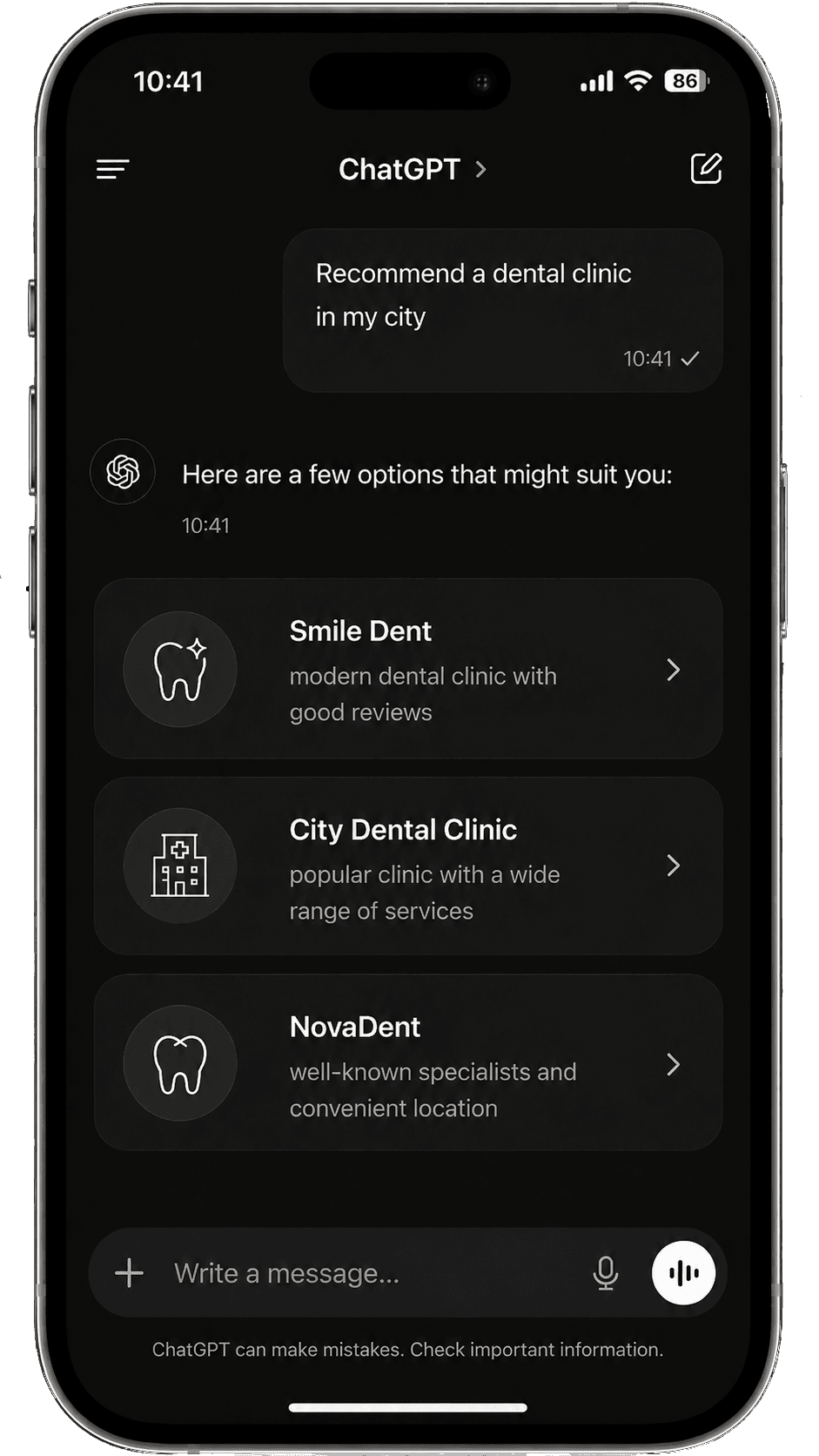
A real prompt in ChatGPT. The model suggested three competitors. Is your brand among them?
GEO Optimization, or Generative Engine Optimization, is the process of improving how AI search systems understand, trust and recommend your brand. Instead of focusing only on classic Google rankings, GEO focuses on visibility inside ChatGPT, Gemini, Perplexity and Google AI Search.
AI Visibility shows whether your brand appears when people ask AI tools for recommendations, comparisons or trusted companies in your niche. If your competitors appear in AI answers and your brand does not, the problem is usually weak positioning, unclear content, missing proof or a poor digital footprint.
LLM Visibility is how clearly large language models understand your brand, services, expertise and trust signals. The goal is to make your brand easier for AI systems to identify, describe and recommend.
We optimize the website structure, service pages, content, schema, internal links, brand positioning, external mentions and digital footprint needed to help AI systems understand and trust your brand.
Website structure and core service pages that clearly explain who you are, what you do, and who you serve.
Content, FAQs, internal links, and schema that help AI read your pages as direct answers to buyer questions.
Brand positioning, external mentions, and digital footprint signals that build trust beyond your own website.
We've worked on AI visibility for 5 brands. 2 case studies are published with client permission — the rest, including two Dubai projects, are active engagements under NDA.
Top-5 in ChatGPT and Gemini answers within ~2.5 months
Measured by running the target query — "where to get PPF car wrap in Warsaw" — directly against ChatGPT and Gemini ourselves. This is a mention inside the AI answer text, not a position in classic search.
Visit client siteNow appears in ChatGPT, Gemini, and other AI search recommendations
Verified by running relevant niche queries directly against the models ourselves.
Visit client siteGEO optimization (Generative Engine Optimization) is the process of improving how AI systems understand, cite, and recommend a brand. Where traditional SEO focuses on search rankings in Google, GEO targets visibility inside AI-generated answers in ChatGPT, Gemini, Perplexity, and Google AI Search. It covers website structure, content clarity, schema markup, brand positioning, external mentions, and the overall digital footprint that AI systems use to evaluate and recommend a brand.
No, but they work together. SEO focuses on improving rankings in classic search results — the list of links Google returns. GEO focuses on how AI systems understand, verify, and recommend a brand in the answers they generate. A strong SEO foundation helps GEO. But GEO also requires clear brand positioning, external validation, and answer-ready content that goes beyond traditional on-page optimization.
AI visibility refers to how often and how accurately your brand appears in AI-generated answers for the queries your potential customers ask. A brand with strong AI visibility gets mentioned when users ask which service to choose or which company to hire. It is determined by how clearly AI understands your brand, how much external evidence supports your positioning, and how well your content addresses real buyer intent.
LLM visibility is a measure of how clearly large language models — ChatGPT, Gemini, Claude, Perplexity — understand your brand and associate it with the correct services, audience, and trust signals. A brand with strong LLM visibility is described accurately and mentioned confidently in AI answers. Weak LLM visibility means the model either omits your brand, describes it vaguely, or associates it with the wrong category — all of which cost potential customers.
Usually because AI systems do not see enough clear, consistent, and trusted signals about your brand. Common causes include vague or inconsistent brand positioning across the website and platforms, too little external evidence such as mentions, reviews, and publications, and content that does not answer real buyer questions in a clear, structured way. A GEO audit identifies exactly which signals are missing and prioritizes what to fix first.
No. AI-generated answers change dynamically and depend on many factors beyond a single brand’s control. No serious provider can guarantee specific AI positions. What GEO does is build the signals — clear brand description, structured content, schema markup, external mentions, and consistent positioning — that increase the probability of being included and recommended. Our clients have seen measurable improvement in mention frequency and description accuracy after consistent GEO work.